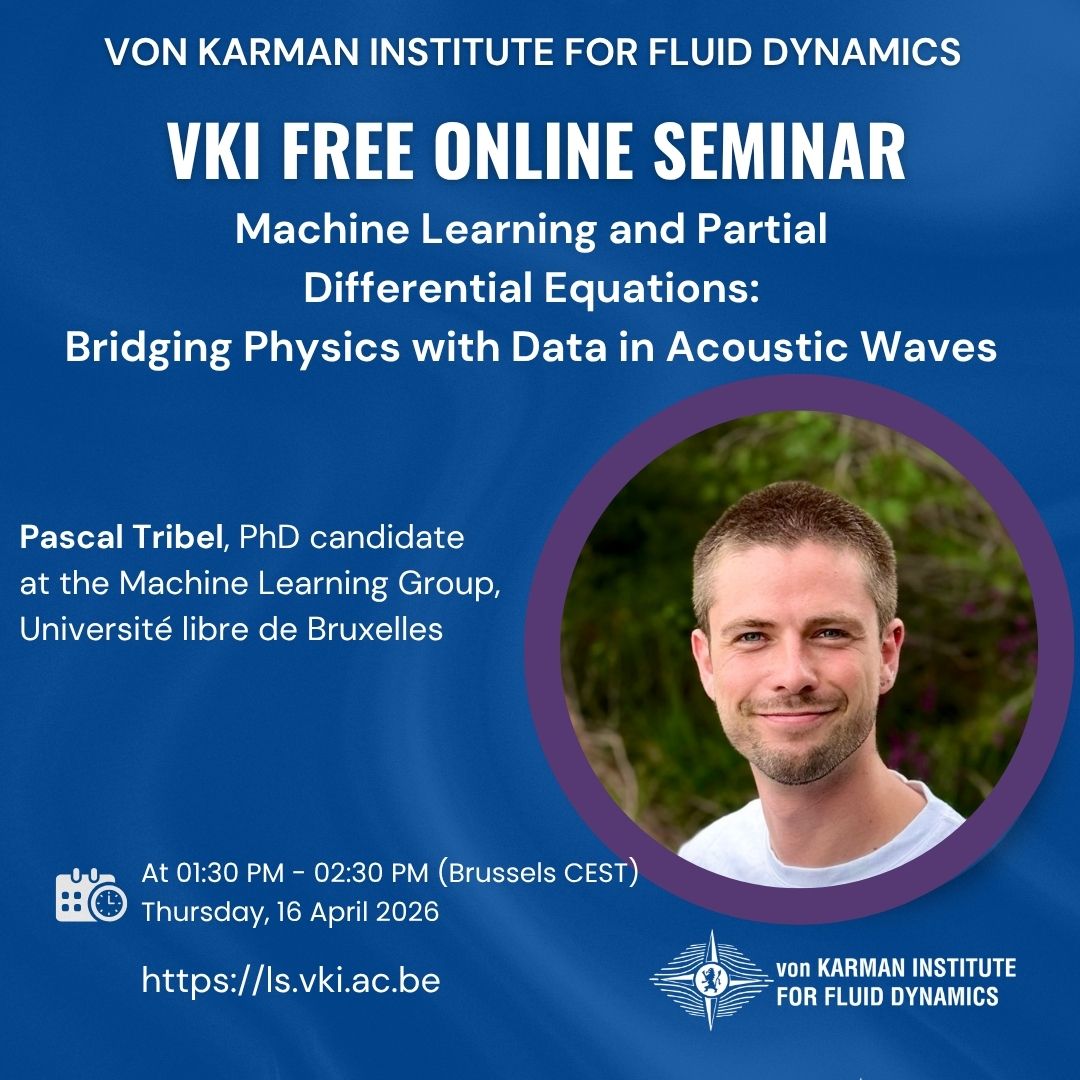
You are warmly invited to attend the seminar “Machine Learning and Partial Differential Equations: Bridging Physics with Data in Acoustic Waves”, presented by Pascal tribel, PhD candidate at ULB (Université Libre de Bruxelles).
The seminar will be held online on Thursday, 16 April, 2026 from 01:30pm to 02:30pm (Brussels CEST).
Participation is free, but registration is mandatory. Before registering, please check the VKI eligibility criteria.
If you are eligible to attend, you will receive the connection link a few days before the event.
Spatio-temporal dynamical systems often pose important challenges to machine learning applications: real-world observations are scarce, partial, and expensive to acquire. How can existing physical knowledge for those systems, usually formalized as Partial Differential Equations, be leveraged to improve both predictive and inverse problem solving, when measurements cover only a fraction of the spatio-temporal field, and when numerical solvers introduce systematic errors that accumulate over time? Conversely, how can measured data help improving the physics described by PDEs?
This seminar explores the interplay between physical models and learning-based methods, building on the solver-in-the-loop framework and its extensions. We present in particular an instantiation of the Deep Finite Difference Method (Deep FDM) on two-dimensional heterogeneous acoustic wave propagation. By pairing a fourth-order finite difference proxy solver with a pseudo-spectral reference, we cast numerical dispersion correction as an operator learning problem and systematically benchmark numerous architectures, from linear regression to Fourier Neural Operators. Results highlight the superiority of neural operators in capturing the residual non-linear relationship between the two solutions, and raise broader questions about the transferable aspect of this benchmark to the simulation-to-reality gap, as well as to other spatio-temporal dynamical systems.
Biography: Pascal Tribel is a doctoral student at the Machine Learning Group (ULB), under the supevision of Gianluca Bontempi. He holds a position as a teaching assistant in the Computer Science Department, for courses of Programming, Modelisation and Simulation, Artificial Intelligence and Machine Learning. His research focuses on applying machine learning techniques to forecasting and analysing temporal and spatio-temporal data that are traditionally described by partial differential equations. Additionally, Pascal Tribel is a pianist who graduated from the Royal Conservatory of Brussels.
Before registering, please check the VKI eligibility criteria.
Sales Conditions:
Free Seminar: Machine Learning and Partial Differential Equations: Bridging Physics with Data in Acoustic Waves
**Early Bird Limit: April 16, 2026
By purchasing this product you agree with our sales conditions.
On site participation is subjcted to Belgian VAT.
Online participation follows current EU VAT and Export rules and depends from the customer country and status (B2B or B2C); values are computed at checkout.
Early Bird Registration Deadline: April 16, 2026
Wire Transfer Payment Deadline: April 6, 2026