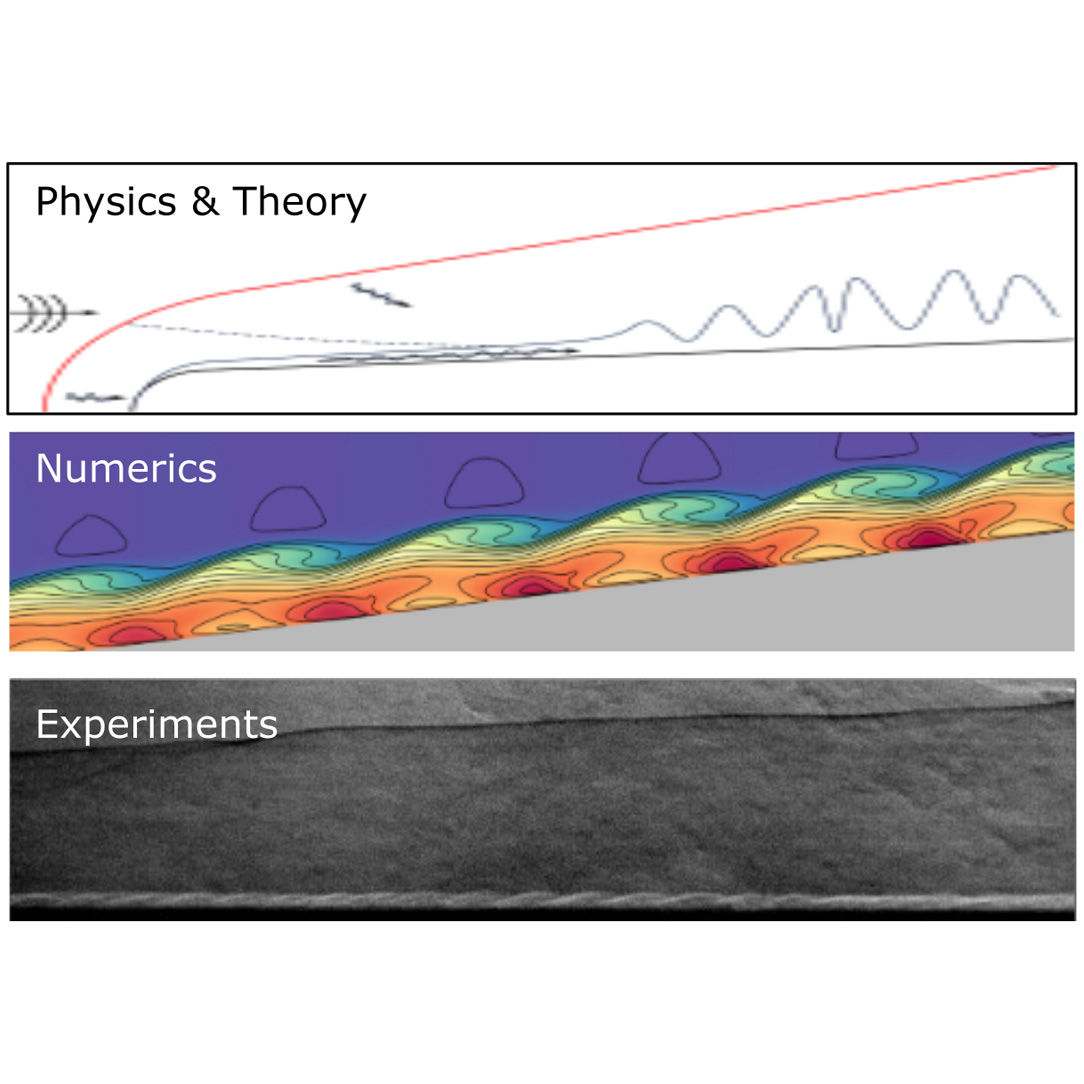
Flow instability analysis is crucial for identifying and understanding some of the most complex challenges in fluid mechanics. Its applications span a wide range of industrial interests, from hypersonic spacecraft and detached flows in aero-engines to aeroacoustics interactions and drag reduction in air vehicles. Nowadays, the availability of new experimental data and high- fidelity numerical solutions combined with the power of machine learning techniques has led to unprecedented opportunities for the advancement of transitional fluid dynamics understanding and its use in industrial design.
The lecture series will introduce several aspects of the stability theory with a particular focus on compressible flows. It will address numerical methods to predict and models transitional flows (linear and non-linear stability theory, transient growth or resolvent analysis). Engineering approaches to be used for design purposes will be discussed as well as the role of machine learning to compute more accurate efficient model. Finally, measurement methods and experimental techniques will be presented.
The lecture series directors are Professors Pierre Schrooyen and Guillaume Grossir from the von Karman Institute for Fluid Dynamics, Belgium.
- Deadline for on-site registration: 16 February 2026
- Deadline for online registration: 23 February 2026
Preliminary Agenda
Monday 2 March 2026
08:30 - 09:00 Welcoming participants
09:00 - 09:30 VKI: Welcome introduction
09:30 - 11:00 Introduction to Laminar-Turbulent Transition
Prof. Neil Sandham, University of Southampton, United Kingdom
11:00 - 11:15 Coffee break
11:15 - 12:45 Boundary layer transition mechanisms in the high-speed flow regime
Dr. Olaf Marxen, University of Surrey, United Kingdom
12:45 - 13:45 Lunch
13:45 - 15:15 Boundary layer receptivity
Prof. Neil Sandham, University of Southampton, United Kingdom
15:15 - 15:30 Coffee Break
15:30 - 17:15 Visit of VKI facilities
17:15 - 18:15 Ice breaking cocktail
Tuesday 03 March 2026
09:00 - 10:30 Linear and non-linear methods for stability analysis
Mr. Stefan Hein, German Aerospace Center (DLR), Germany
10:30 - 10:45 Coffee break
10:45 - 12:15 On transient growth
Dr. Pedro Paredes, NASA Langley Research Center, The Unites Sates of America
12:15 - 13:15 Lunch
13:15 - 14:45 High fidelity simulation for high-speed transitional flows
Prof. Paola Cinnella, Sorbonne Université, France
14:45 - 15:00 Coffee break
15:00 - 16:30 Resolvent / input-output analysis
Dr. Samir Beneddine, ONERA, France
Wednesday 4 March2026
09:00 - 10:30 RANS modeling for transitional flow
Dr.-Ing. Florian Menter, ANSYS, Germany
10:30 - 10:45 Coffee break
10:45 - 12:15 Transition Impact on High-Speed Vehicle Design: Engineering Methodologies for Transition Onset and Extent”
Dr. Johan Steelant, European Space Agency (ESA), The Netherlands
12:15 - 13:15 Lunch
13:15 - 14:45 How machine learning can be exploited to predict transition?
Dr. Pedro Paredes, NASA Langley Research Center, The Unites Sates of America
14:45 - 15:00 Coffee break
15:00 - 16:30 On the design of hypersonic quiet facilities
Prof. Guillaume Grossir, von Karman Institute for Fluid Dynamics (VKI), Belgium
Thursday 5 March 2026
08:45 - 10:15 Focused Laser Differential Interferometry for Hypersonic Instability Measurements
Dr. Leonardo Saenz, von Karman Institute for Fluid Dynamics (VKI), Belgium
10:15 - 10:30 Coffee break
10:30 - 12:00 Experimental characterization of the hypersonic boundary layer transition process
Prof. Jonathan Hill Embry-Riddle Aeroautical University (ERAU), The United States of America
12:00 - 13:00 Lunch
13:00 - 14:30 Transition experiments in a high-density tunnel
Prof. Matthew McGilvray, University of OXford, United Kingdom
14:30 - 14:45 Coffee break
14:45 - 16:15 Temperature sensitive paint
Dr. Jan Martinez Schramm, Leni Schmidt, and Divek Surujhlal, German Aerospace Center (DLR), Germany
Before registering, please check the VKI eligibility criteria.
Sales Conditions:
Introduction to Boundary Layer Stability and Transition Analysis Methods
By purchasing this product you agree with our sales conditions.
On site participation is subjcted to Belgian VAT.
Online participation follows current EU VAT and Export rules and depends from the customer country and status (B2B or B2C); values are computed at checkout.